
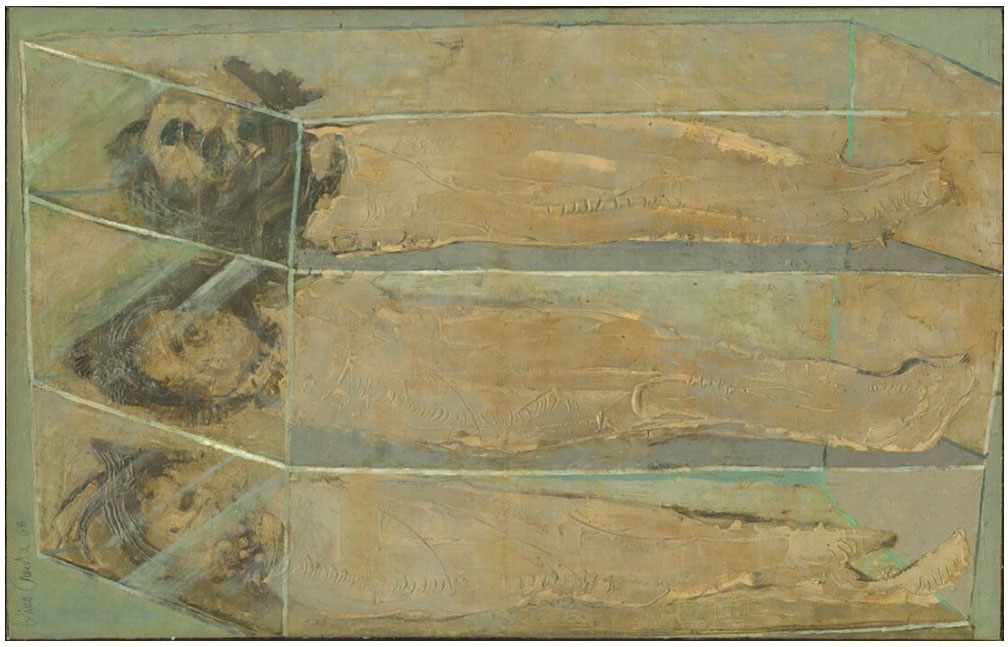
The story behind Three Figures is considerably darker than its abstract appearance might initially suggest. Aranda was born in Managua, Nicaragua, in 1945 and came of age under the Somoza family dictatorship, which ruled Nicaragua from 1936 until 1979. In the late 1960s, he created a series of paintings addressing political repression and the violence occurring in his homeland. Three Figures belongs to that series and was created in response to the murder of students during the Somoza regime.
The cage-like structures are therefore not simply geometric devices. They symbolize imprisonment, confinement and the loss of human freedom. The three bodies appear trapped within these structures, transforming what might otherwise be ordinary human figures into victims whose individuality has been stripped away. Contemporary accounts of Aranda’s work describe his early figures as bodies crowded into cages, a visual representation of the fear, suffering and political oppression experienced in Nicaragua.
There is also an important progression in Aranda’s imagery. According to accounts of his career, the cages that appear in these early works would later evolve into coffins and eventually narrow crypts populated by increasingly skeletal figures. As the political situation in Nicaragua deteriorated, his paintings became darker and more monochromatic. Following the overthrow of the Somoza dictatorship in 1979, color gradually returned to his work.
What makes Three Figures especially compelling is the contrast between its formal beauty and its subject matter. From a distance, the painting can appear almost serene: three pale, horizontal forms suspended against a cool green-blue field. Closer examination reveals something far more disturbing—the suggestion of human beings confined and powerless. Aranda used abstraction not to obscure the political message, but to make the tragedy universal. The figures are not individualized portraits; they can represent the countless victims of political violence whose identities and voices were suppressed.
In this sense, Three Figures is both a historical document and a deeply human statement. It records Aranda’s response to the political violence of his native Nicaragua while confronting broader themes of oppression, mortality, fear and the fragility of human freedom. The painting’s placement today in the National Gallery of Art gives it an additional dimension: what began as one artist’s response to violence in Nicaragua has become part of America’s permanent cultural record of modern and contemporary art.